When a fabrication shop begins a new project—whether it’s a warehouse gate, a machine frame, or structural support—one material shows up in almost every requirement: MS Flat Bar. Its simplicity and versatility make it a go-to choice across construction, manufacturing, automotive, and infrastructure projects.
But before purchasing MS flat bars in bulk, professionals need clarity on sizes, weight, price per kg, load suitability, and comparison with other mild steel products. This guide breaks down everything in a practical, B2B-friendly format so that contractors, fabricators, and traders can make confident buying decisions.
What Are MS Flat Bars?
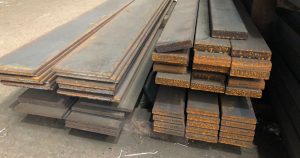
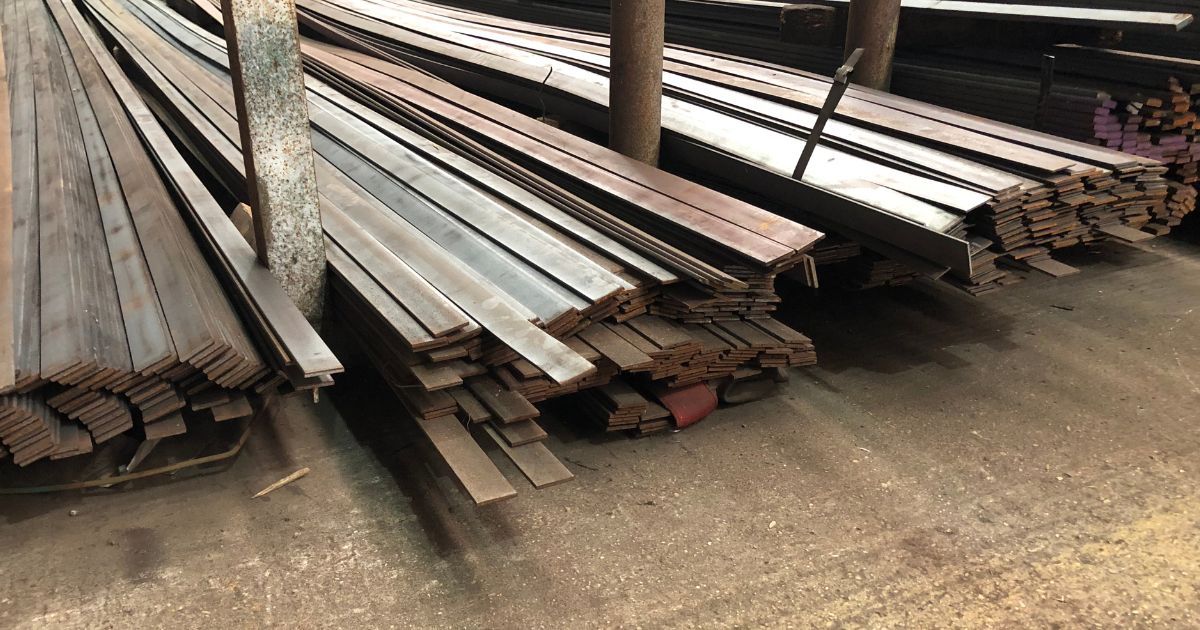
MS (Mild Steel) Flat Bars are rectangular-shaped steel sections with a wide range of width-to-thickness combinations. Their uniform shape ensures excellent strength distribution, easy welding, and smooth fabrication.
They are commonly used in:
- Support frames and base plates
- Industrial machinery components
- Brackets, clamps, and fittings
- Gratings and platforms
- Decorative steelwork
- Gate and grill fabrication
- Infrastructure reinforcement
MS Flat Bar Sizes (Standard Dimensions)
Flat bars are available in multiple width and thickness combinations. Here is the most commonly used MS Flat Bar Size Chart for industrial projects:
MS Flat Bar Size Chart (mm)
| Width (mm) | Thickness (mm) | Area (sq.mm) | Weight (kg/m) |
| 20 | 3 | 60 | 0.47 |
| 25 | 5 | 125 | 0.98 |
| 32 | 6 | 192 | 1.50 |
| 40 | 6 | 240 | 1.88 |
| 50 | 8 | 400 | 3.14 |
| 65 | 10 | 650 | 5.11 |
| 75 | 10 | 750 | 5.89 |
| 100 | 12 | 1200 | 9.42 |
Weight is calculated using the standard formula: Density of MS = 7.85 g/cm³.
MS Flat Bar Weight Calculation Formula
If your project requires accuracy in load bearing and cost estimation, use this universal formula:
Weight (kg/m) = (Width × Thickness × 7.85) / 1000
Example:
50mm × 6mm = (50 × 6 × 7.85) / 1000 = 2.355 kg/m
Types of MS Flat Bars
Understanding types helps in selecting the correct variant for industrial use:
1. Hot Rolled (HR) Flat Bars
- Most widely used
- Suitable for structural, heavy-duty, and fabrication work
- Rough finish but high strength
2. Cold Rolled (CR) Flat Bars
- Smooth finish
- More precise dimensioning
- Preferred in decorative, furniture, and precision manufacturing
3. Customized Cut Flats
- Made from plates via shearing
- Used for machine parts and component-level fabrication
Applications in Construction & Industry
Construction Contractors
- Foundation & plinth levels
- Beams, lintels, and support plates
- Window grill frames and railing structures
Industrial Fabricators
- Conveyor systems
- Bracket manufacturing
- Machinery base plates and supports
Plumbing / Infrastructure Companies
- Cable tray supports
- Drainage channel frames
- Mounting plates for industrial utilities
Hardware Dealers / Traders
- High-demand product with fast movement
- Ideal for bulk stocking
Comparison: MS Flat Bar vs MS Angle vs MS Channel
| Feature | MS Flat Bar | MS Angle | MS Channel |
| Shape | Rectangular | L-shaped | C-shaped |
| Strength | Moderate | High | Very High |
| Best For | Fabrication, fittings, grills | Structural support | Heavy load frames |
| Flexibility | Very high | Medium | Low |
MS Flat Bar Price Per Kg (2025 Market Overview)
Prices vary based on:
- Raw steel market
- Supply-demand cycles
- Thickness & width
- Quality and rolling process
- Transportation and GST
Average Price Range (2025 India Market):
₹55 – ₹72 per kg
Heavier sizes generally cost slightly more due to higher rolling effort.
Factors Affecting MS Flat Bar Price
1. Raw Material Cost
Iron ore and billet prices directly influence MS flat bar pricing.
2. Manufacturing Process
Cold rolling increases cost due to extra finishing steps.
3. Size & Thickness
Thicker bars require more material → higher price per meter.
4. Market Demand
Industrial seasons like pre-monsoon and government tender phases cause price fluctuations.
If you’re also working with reinforcement structures, you may find our detailed guide on TMT Bar grades and construction suitability extremely helpful. It explains how the right TMT bar grade improves structural strength—something crucial when flat bars are used as support plates or welded components.
Conclusion
MS Flat Bars are essential for hundreds of industrial and structural applications, and choosing the correct size and thickness ensures durability, accuracy, and cost-efficiency. Whether you’re a contractor estimating loads, a fabricator welding machine frames, or a trader stocking high-demand steel—flat bars remain a universally required product.
If you’re a contractor, fabricator, or industrial trader looking for all MS products in a single place, Udhhyog Industrial Catalyst simplifies procurement. You can source MS flat bars in multiple sizes, HR/CR variants, and accurate weight ranges, along with MS pipes, angles, channels, and plates—all at affordable and transparent rates.
What size and thickness do you need for your next project, and would you like support in sourcing the best quality material?
You can also explore our Pipe category for more related products.