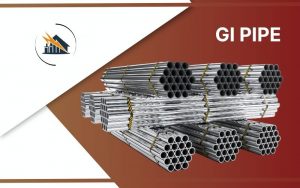
GI pipes, or Galvanised Iron pipes, are among the most widely used piping materials across construction, agriculture, infrastructure, and industrial applications. Their zinc-coated exterior gives them unmatched corrosion resistance, strength, and long service life, making them a preferred choice over MS pipe, iron pipe, or even certain stainless steel pipe applications where cost and durability must be balanced. For buyers comparing options like GI pipe, MS pipe, SS pipe, square pipe, ERW pipe, or general steel pipe price trends, understanding their specifications and use-cases is essential.
At Udhhyog, we bring clarity to the world of steel and raw material products by sharing accurate and well-researched information. This detailed guide covers everything you need to know about GI pipes, including their manufacturing process, classifications, applications, advantages, key comparisons, and pricing considerations in India.
GI pipes are manufactured using low-carbon mild steel coils. These coils are shaped, welded, and then coated with zinc to form galvanised pipes that can withstand environmental exposure, moisture, and long-term usage. The zinc layer serves two main functions: it creates a barrier that prevents rust from forming, and it acts as a sacrificial layer—meaning the zinc corrodes first, protecting the steel beneath. This is why GI pipes remain intact for decades even in harsh water, soil, and weather conditions.
GI Pipe Manufacturing: How the Pipes Are Made
Manufacturing GI pipes involves multiple precision steps designed to ensure dimensional accuracy and superior corrosion resistance. High-grade MS steel strips are slit and shaped into circular profiles using fin rolls. The edges are then welded together using high-frequency electric resistance welding, forming the base of ERW pipe.
After welding, the pipes pass through sizing sections where their dimensions are corrected for accuracy. This stage ensures uniformity, which is especially important for pressure-bearing applications. The pipes are then cut into specific lengths and tested for leaks, ensuring no defects compromise performance. Once the structural pipe is ready, it undergoes galvanisation—either hot-dip or electro-galvanising—both of which deliver long-term protection.
Classifications of GI Pipes
As per IS:1239 standards, GI pipes are classified into three major categories based on thickness and suitability:
1. Class A (Light Gauge)
These pipes have the thinnest wall section and are cost-effective, lightweight, and suitable for low-pressure applications such as domestic plumbing, wiring conduits, and lightweight fencing.
2. Class B (Medium Gauge)
These are the most widely used GI pipes due to their balance of strength, durability, and affordability. They are ideal for agricultural irrigation, municipal water distribution, and medium-pressure applications.
3. Class C (Heavy Gauge)
Known for maximum thickness and durability, Class C GI pipes are used in fire safety systems, scaffolding, heavy water distribution, industrial pipelines, and other high-pressure applications.
Understanding these categories helps buyers choose the correct type depending on pressure, load requirements, and application environment.
GI Pipe vs MS Pipe vs SS Pipe
To help customers make informed decisions, here is a simple comparison:
- GI Pipe: MS pipe coated with zinc for corrosion resistance. Best for water supply, agriculture, structural work, and sewage lines.
- MS Pipe: Uncoated mild steel pipe; more economical but prone to rust when exposed to moisture.
- SS Pipe: Stainless steel pipe with maximum corrosion resistance, but significantly more expensive. Often used in high-purity or chemical environments.
Many buyers search for “GI pipe price”, “steel pipe price”, “SS pipe price”, or “iron pipe price” to compare options. While stainless steel offers superior durability, GI pipes provide the best balance of price and performance for general applications.
Applications of GI Pipes
GI pipes are used across multiple sectors, thanks to their versatility and mechanical strength.
Agriculture and Borewell Applications
GI pipes are essential for water supply in irrigation systems, borewell casings, underground supply lines, and rural water networks. Their corrosion resistance ensures reliable performance even in moisture-rich soil conditions.
Construction and Structural Use
From scaffolding to support structures and framework installations, GI pipes resist load, pressure, and external weathering, making them ideal for long-term construction work.
Water Supply and Sewage Lines
Their anti-rust properties make them suitable for transporting treated and untreated water over long distances.
Engineering and Industrial Use
GI pipes are widely used in automotive components, oil and gas pipelines, fabrication units, and other engineering fields requiring durable piping.
Electrical and Communication Use
They serve as conduits for electrical wiring, telecom cable protection, and pole installations due to their strength and non-corrosive finish.
Key Benefits of GI Pipes
- Excellent corrosion resistance
- Long life expectancy of 20–50 years
- Strong structural integrity
- Easy to cut, thread, and fabricate
- Cost-effective compared to stainless steel
- Eco-friendly and fully recyclable
- Leak-proof performance in water systems
Price Considerations
Several factors affect GI pipe price in India:
- Thickness and class (A/B/C)
- Diameter and length
- Zinc coating thickness
- Brand and manufacturing quality
- Regional steel and raw material market fluctuations
Udhhyog regularly tracks steel pipe price variations to help buyers make informed decisions.
GI pipes remain a cornerstone material across industries due to their durability, affordability, and lifespan. Whether you’re comparing MS pipe, SS pipe, square pipe, or ERW pipe options, GI pipes stand out for their long-term value and proven performance.