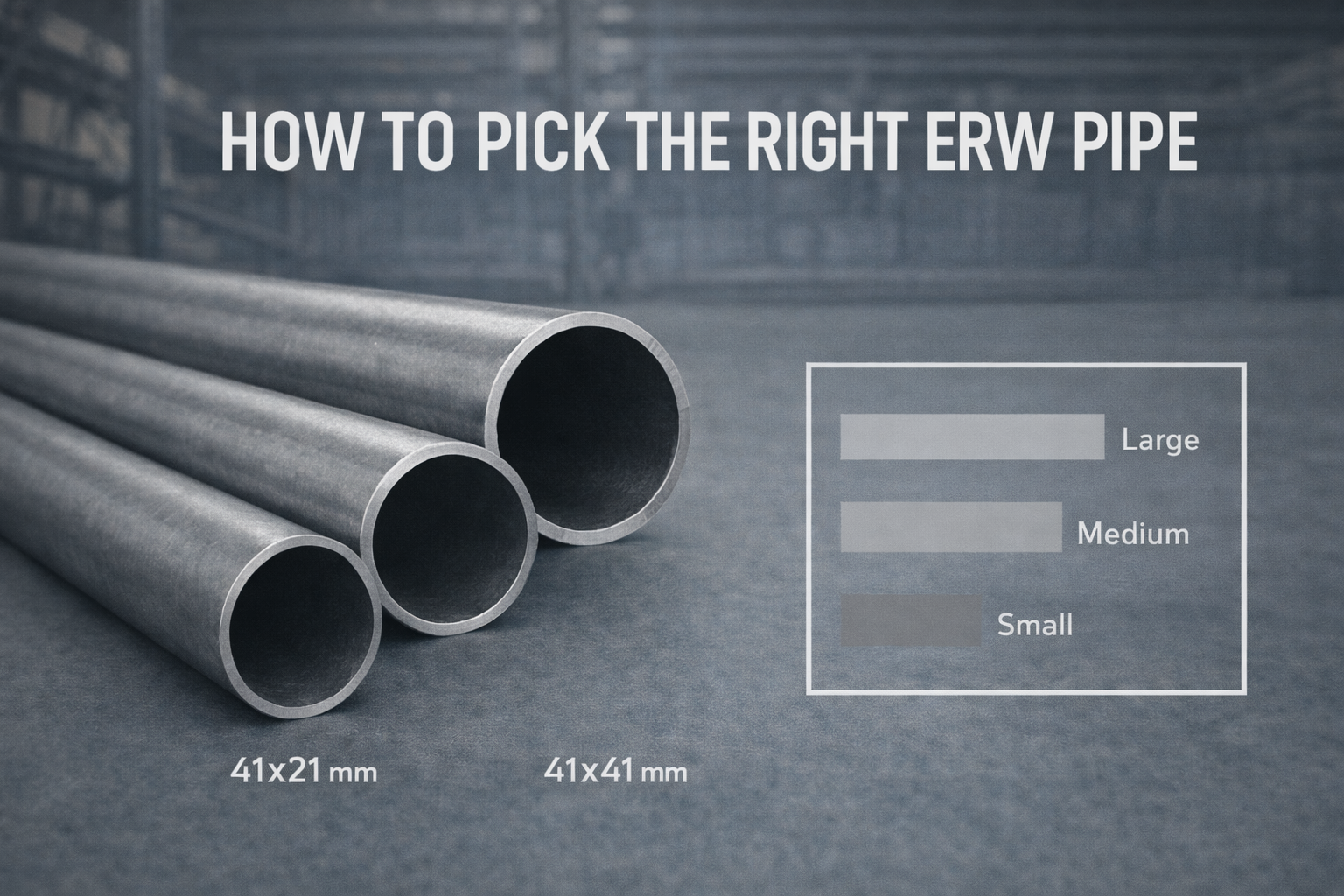
Choosing the right ERW pipe is important for strength, safety, and long service life. ERW pipes are widely used in construction, water lines, scaffolding, fencing, and industrial frameworks. When selected correctly, they offer good strength, smooth finish, and cost control.
This guide explains how ERW pipes are made, where they are used, and how to select the right size and grade for your project.
Must check out our flat category as well.
What Is an ERW Pipe?
ERW stands for Electric Resistance Welded pipe. These pipes are made by rolling steel strips into a round shape and welding the seam using electric resistance. No filler metal is added during welding. This creates a clean joint and uniform thickness across the pipe.
ERW pipes are popular because they are consistent in quality and suitable for both light and medium-load applications.
Common Uses of ERW Pipes
ERW pipes are used across many industries due to their versatility.
- Water and drainage pipelines
- Structural frameworks and sheds
- Scaffolding and handrails
- Agricultural piping systems
- Furniture and fabrication work
Their smooth surface also makes them easy to paint or galvanize.
ERW Pipe Types and Sizes
ERW pipes are available in different finishes and thicknesses. The most common types include black ERW pipes and galvanized ERW pipes.
ERW Pipe Size Chart
| Pipe Size (Inch) | Thickness (mm) | Common Application |
|---|---|---|
| ½ inch | 1.6 – 2.0 | Light plumbing and fencing |
| 1 inch | 2.0 – 2.5 | Water lines and railings |
| 2 inch | 2.5 – 3.2 | Structural frames |
| 3 inch | 3.2 – 4.0 | Columns and supports |
| 4 inch | 4.0 – 5.0 | Industrial pipelines |
Note: Thickness choice depends on load and pressure needs.
How to Choose the Right ERW Pipe
Before selecting an ERW pipe, consider these factors:
Load Requirement
Higher loads need thicker pipes. Thin pipes may bend under pressure.
Environment
For outdoor use, galvanized ERW pipes perform better due to corrosion resistance.
Pipe Length and Jointing
Longer spans require stronger pipes to avoid sagging.
Future Usage
If expansion is expect later then always allow extra capacity
ERW Pipe vs Seamless Pipe
ERW pipes are cost-effective and suitable for most general uses. Seamless pipes are preferreable only when very high pressure or extreme temperature resistance is a requirement. For normal construction and industrial use, ERW pipes are a practical choice.
Industrial Supply and Quality Consistency
Large projects need uniform quality and steady availability. Many contractors rely on Udhhyog for industrial steel requirements, including ERW pipes in bulk. Consistent sizing and surface quality help reduce installation issues and project delays.
Common Mistakes to Avoid
- Choosing pipe only by price
- Ignoring thickness and load rating
- Using non-galvanized pipes outdoors
- Incorrect support spacing
Avoiding these mistakes improves safety and pipe life.
Conclusion
Selecting the right ERW pipe ensures durability, cost control, and smooth installation. By understanding size, thickness, finish, and application needs, you can make a reliable choice for any project. Proper planning and trusted supply sources make ERW pipes a dependable solution across industries.